When you look at the numbers today, the one thing that stands out is the strength of this housing market. We can see this is one of the most foundationally strong housing markets of our lifetime – if not the strongest housing market of our lifetime. Here are two fundamentals that prove this point.

1. The Current Mortgage Rate on Existing Mortgages
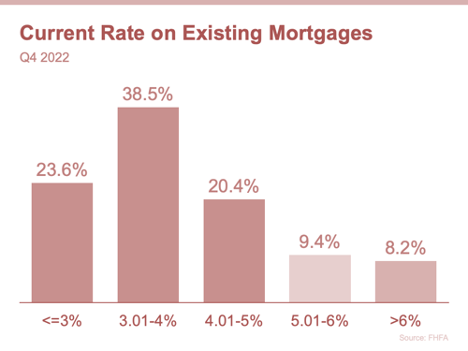
First, let’s look at the current rate on existing mortgages. According to the Federal Housing Finance Agency (FHFA), as of the fourth quarter of last year, over 80% of existing mortgages have a rate below 5%. That’s significant. And, to take that one step further, over 50% of mortgages have a rate below 4% (see graph below):

Now, there’s a lot of talk in the media about a potential foreclosure crisis or a rise of homeowners defaulting on their loans, but consider this. Homeowners with such good mortgage rates are going to work as hard as they can to keep that mortgage and stay in their homes. That’s because they can’t go out and buy another house, or even rent an apartment, and pay what they do today. Their current mortgage payment is more affordable. Even if they downsize, with today’s higher mortgage rates, it could cost more.

Here’s why this gives the housing market such a solid foundation today. Having so many homeowners with such low mortgage rates helps us avoid a crisis with a flood of foreclosures coming to market like there was back in 2008.

2. The Amount of Homeowner Equity
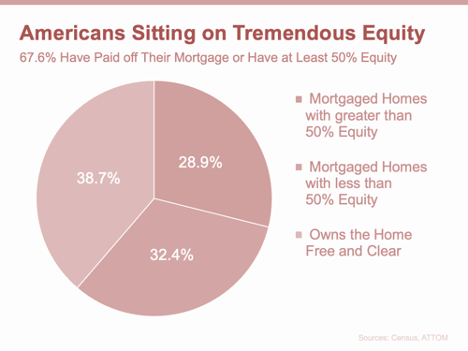
Second, Americans are sitting on tremendous equity right now. According to the Census and ATTOM, roughly two-thirds (around 68%) of homeowners have either paid off their mortgage or have at least 50% equity (see chart below):

In the industry, the term for this is equity rich. This is significant because if you think back to 2008, some people had to make the difficult decision to walk away from their homes because they owed more on the home than it was worth.

But this time, things are different because homeowners have built up so much equity over the past few years alone. And, when homeowners have that much equity, it helps us avoid another wave of distressed properties coming onto the market like we saw during the crash. It also creates an extremely strong foundation for today’s housing market.

We are in one of the most foundationally strong housing markets of our lifetime because homeowners are going to fight to keep their current mortgage rate and they have a tremendous amount of equity. This is yet another reason things are fundamentally different than in 2008.

You’ve found the perfect new apartment or rental house. You love the neighborhood. Your application has been approved. You’re ready to sign on the dotted line, right?

Not so fast. How much do you know about your soon-to-be landlord, property manager or property management company?

There are lots of reasons why you should take the time to ask yourself, “Who is my landlord?” before you commit. Your rent payment is likely one of your biggest monthly expenses, and if you’re signing a lengthy lease, you should find out as much as you can about the person who owns and operates the place you’ll call home.

Check out these five easy ways to check your landlord’s reputation before signing your lease.

1. Google them
The internet has a way of quickly uncovering all kinds of misdeeds, so start with a simple Google search of your landlord’s name or property management company, as well as the property address.
Hell hath no fury like a renter scorned, so you’ll also want to peruse some of the many apartment and landlord review sites online that let tenants anonymously review their apartment complex, landlord or property management company.

2. Search public records
There’s a wealth of information about properties and landlords available via your local government agencies, and you’re usually able to check your landlord for free. Consider it your landlord background check!
Your county courthouse should have ownership records searchable by address, so you can find the legal name of the person or company that owns the property — it may not be your landlord directly.
You can also search for code violations, foreclosure proceedings, evictions, and small claims court settlements, all of which should be red flags for renters.

3. Get to know your (future) neighbors
If you’re moving into an apartment complex with multiple units, take a few minutes to walk around the grounds out of earshot of the landlord.
If you see any tenants out and about, strike up a conversation about what it’s like to live there. Ask how long they’ve lived there — renewed leases are a good sign of a positive landlord-tenant relationship. Get a few pros and cons, ask how complaints are handled, and find out if they have any gripes about management.
If you’re moving into a single-family home, ask the landlord if they’d mind you having a conversation with the current tenants.
If you don’t have access to any other tenants, find a neighborhood-specific blog or Facebook group to join. Tell people you’re thinking of moving into the area and ask if they know anything about the property manager.

4. Be the interviewer
Landlords ask you questions when you apply to live in their property, so why shouldn’t you ask them questions too?
Ask them how they handle repair requests. Find out if the landlord lives on-site, nearby or in a different state. Ask how the move-in and move-out process goes. Learn more about their process for requesting entry to your unit.
They should be able to easily answer your questions and address all of your concerns.

5. Go with your gut
When in doubt, trust your instincts. If you experience any of the following:

  • The price seems too low for the apartment size, amenities, or neighborhood
  • The lease terms are unclear
  • The landlord is hesitant to answer your questions
  • The landlord tries to rush you through the rental process

Think twice — and keep looking.

Buying and owning your home can make a big difference in your life by bringing you joy and a sense of belonging. And with National Homeownership Month just passed us, it’s the perfect time to think about all the benefits homeownership provides.

Of course, there are financial reasons to buy a house, but it’s important to consider the non-financial benefits that make a home more than just where you live.

Here are three ways owning your home can give you a sense of accomplishment, happiness, and pride:

  1. You May Feel Happier and More Fulfilled
    Owning a home is associated with better mental health and well-being. Studies have shown the emotional and psychological benefits that homeownership has on a person’s health and self-esteem. According to Habitat for Humanity, Residential stability among homeowners is related to improved life satisfaction, along with better physical and mental health.
    So, according to the experts, owning a home can improve your psychological wellness by making you feel happier and more accomplished.
  2. You Can Engage in Your Neighborhood and Grow Your Sense of Community
    Your home connects you to your community. Homeowners tend to stay in their homes longer than renters, and that can help you feel more connected to your community because you have more time to build meaningful relationships. When people stay in the same area for a longer period of time, it can lead to them being more involved: Homeowners also tend to be more active in their local communities.
    After all, it makes sense that someone would want to help improve the area they’re going to be living in for a while.
  3. You Can Customize and Improve Your Living Space
    Your home is a place that’s all yours. When you own it, unless there are specific homeowner’s association requirements, you’re free to customize it however you see fit. Whether that’s small home improvements or full-on renovations, your house can be exactly what you want and need it to be. As your tastes and lifestyle change, so can your home. One major benefit of homeownership is the knowledge that you own your little corner of the world. You can customize your house, remodel, paint, and decorate without the need to get permission from a landlord.

Renting can limit your ability to personalize your living space, and even if you do make changes, you may have to undo them before your lease ends. The ability homeownership gives you to customize and improve where you live creates a greater sense of ownership, pride, and connection with your home.

Owning your home can change your life in a way that gives you greater satisfaction and happiness. Let’s connect today if you’re ready to explore homeownership and all it has to offer.

Securing a home loan and buying a house after bankruptcy may sound like an impossible feat. Blame it on all those Monopoly games, but bankruptcy has a very bad rap, painting the filer as someone who should never be loaned money. The reality is that of the 600,000 Americans who file for bankruptcy every year, most are well-intentioned, responsible people. Life has thrown them a curveball, however, that has left them struggling to pay off their past debts. Sometimes, filing for bankruptcy is the only way out of a crushing financial situation, and taking this step can really help cash-strapped individuals get back on their feet. And yes, many go on to become first-time home buyers or buy a home eventually, despite the challenging credit score that results from bankruptcy. But how? Being aware of what a lender expects after a bankruptcy will help you navigate the mortgage application process efficiently and effectively. Here are the steps on buying a house after bankruptcy, and the top things you need to know:

Types of bankruptcy: The best and the worst

There are two ways to file: Chapter 7 bankruptcy and Chapter 13 bankruptcy. With Chapter 7 bankruptcy, filers are typically released from their obligation to pay back unsecured debt—think credit cards, medical bills, or loans extended without collateral. With Chapter 13 bankruptcy, filers have to pay back their debt. However, the debt is reorganized and a new repayment schedule established that makes monthly payments more affordable. Since Chapter 13 filers are still paying back their debts, mortgage lenders generally look more favorably on these consumers than those who file for Chapter 7. A bankruptcy attorney can help determine if Chapter 7 or Chapter 13 makes the most sense for your specific situation. Unfortunately, both Chapter 7 and Chapter 13 bankruptcies will adversely affect credit scores. But don’t give up!

How long after bankruptcy should you wait before buying a house?

Most people applying for a loan will need to wait two years after bankruptcy before lenders will consider their loan application. That said, it could be up to a four-year ban, depending on the individual and type of loan. This is because lenders have different “seasoning” requirements, which is a specified amount of time that needs to pass.

Fannie Mae, for example, has a minimum two-year ban on borrowers who have filed for bankruptcy.  The FHA loan, on the other hand, has a minimum one-year ban in place after a bankruptcy. These bans, or seasoning periods, are typically shorter with government-backed loans (such as FHA or VA loans) than with conventional loans. The time is measured starting from the date of discharge or dismissal of the bankruptcy action. Generally, the more time between debt discharge and the loan application, the less risky a once-bankrupt borrower looks in the eyes of a mortgage lender.

How to reestablish credit after bankruptcy

Once the bankruptcy process is over, reestablishing and maintaining creditworthiness is key to your financial health. Lenders will be looking for zero delinquencies post bankruptcy. While you work to build new credit, don’t go overboard opening an extensive number of accounts, as this will work against you. Usually, opening just a couple of revolving credit lines and paying them in a timely manner over the course of 12 months helps to increase credit scores back to an acceptable level.

What to do before you apply for a mortgage

Before you apply for a mortgage loan, check your credit score by getting copies of your three main credit reports, which detail the financial transactions (and transgressions) from your past. You will want to check these credit reports for errors, such as a credit issue that you resolved but that is not reflected in your report. In some post bankruptcy cases, errors continue to report negatively on credit reports. These mistakes will drag down your overall credit score and reduce your chances of getting approved for the mortgage. So if you spot mistakes on your credit reports, work with the credit bureaus to correct the information they include. This can boost your credit score significantly, and may even tip the scales on your home loan approval. Mortgage lenders want to see any movement from bad credit to good credit, so don’t leave any of your hard-earned progress on the table.

Buying a house after bankruptcy: Ways to woo a lender

To start the mortgage process, lenders require a detailed letter explaining why you needed to file for Chapter 7 or Chapter 13 in the first place. Ideally, the bankruptcy would have been caused by an extenuating circumstance beyond your control—such as the death of an income-contributing spouse, the loss of employment, or a serious illness. In other words: A lender likes to see that you were hit with hard times that had a significant negative impact on your expenses or income, and made it impossible to meet your financial obligations. What a lender won’t want to see is someone with a die-hard shopping habit or a careless attitude toward paying credit cards on time. If that’s you, you’ll have to prove you’ve changed.

Whatever the reason you filed for bankruptcy, lenders will need to properly document your extenuating circumstances, so be prepared to provide proof detailing your life event. Medical bills, a doctor’s note, a death certificate, or severance paperwork are all acceptable evidence that prove to lenders that you are a safe bet worthy of a home loan.

For many of us, visiting the same vacation spot every year is a summer tradition that’s fun, relaxing, and restful. If that sounds like you, now’s the time to think about your plans and determine if buying a vacation home this year makes more sense than renting one again. According to Forbes:

“. . . if the idea of vacationing at the same place every year makes you feel instantaneously relaxed, buying a vacation home might be a wise move.”

To help you decide if making a move like this is right for you, let’s explore why you may want to consider purchasing a vacation home today.

Benefits of Owning Your Vacation Home

  • You don’t have to worry about finding a place to stay. It can be a challenge to find a rental where you want when you want. Some summer vacation destinations are more popular than others, meaning your favorite place may be booked up in advance. Bankrate explains why owning your vacation home means you don’t have to worry about that sort of inconvenience: “. . . a second home can offer a place to have quality time with your family and ensures that you always have a vacation destination.”
  • It’s an investment. Home values typically appreciate over the long haul. That holds true for your vacation home as well, especially if it’s in an area with growing market demand. This can help grow your net worth with time.
  • Vacation homes may provide tax benefits. If you own a vacation home, you may be eligible for tax deductions based on where it is. However, before buying, you’ll want to consult with a tax professional to discuss first as taxes can vary by location.
  • It could potentially turn into a retirement location. If you love the location of your vacation home, you could potentially sell your primary residence and retire there in the future.

How a Pro Can Help You Find Your Perfect Match
As you’re preparing for summer vacation, remember, you could potentially visit your second home instead of another rental unit or hotel. If that sounds appealing to you, a local real estate agent is your best resource. They have the knowledge and resources to help you understand the area and what vacation homes are available in your budget. Plus, these agents can explain the perks of how owning a second home can benefit you.

If any of these reasons for owning a vacation home resonate with you, let’s connect. You still have time to enjoy spending the summer in your vacation home.

There’s a lot to consider when buying a home. You’ve probably asked yourself a million questions already. What’s in my budget? What will my annual tax bill look like? How far am I willing to commute? How are the schools? Of course, that’s all incredibly important. Particularly if you think it might be your forever home.

The next question most people will ask, or should be asking, is what kind of home is right for me? Single family? Condominium? Townhouse? Chateau in the French countryside? So many questions! Over the next few paragraphs, we’ll examine what types of residences, including the most common architectural styles, are available right now to you, the homebuyer.

First, let’s tackle single-family homes. Single-family homes are usually defined as free standing or detached residential structures. There’s some leeway there where properties can be seemingly attached but separated by a wall that extends the full vertical height of the home, roof excluded. As one can imagine, there’s a lot of variety in single-family homes. Several are listed below.

Ranch
A ranch-style home is a single level home. They’re most usually wider than they are tall. There are many reasons to prefer to single level living, including: you don’t want to carry furniture upstairs, you have mobility concerns that make routine stair climbing inconvenient, and/or you prefer an open floor plan that allows you to flow from one end of the square footage to the other without ascending or descending stairs or other obstructions.

Cape Cod
Cape Cods also tend to be single level but not always. This style is most known for its rectangular structure with a side roof that sits lower than the main roof. They’re also known for their compact design so don’t expect vaulted ceilings or oversized rooms. Most rooms are built off a central point in the house, usually a fireplace.

Victorian
If you’ve always dreamed of a library with a sliding ladder, stained glass, a sharp roof, and sprawling gothic staircases, a Victorian might be for you. Named after the era of Queen Victoria, one can easily see high society types in waistcoats and corsets enjoying tea as they discuss the recent developments in the Jack the Ripper case. It’s not uncommon to find remnants of past conveniences like dumbwaiters and large butler’s pantries in these older homes.

Tudor
Tudor homes are most recognizable for the hand-hewn wood beams and cross beams set in masonry, stucco, or elaborate stonework on the exterior of the home. In other words, exposed framing. These homes were very common in the late 19th and early 20th centuries.

Colonial
Colonial homes are about symmetry. They can be made of wood, stone, or brick and feature windows and doors of uniform measurement. Often the windows are accented by shutters and the front door is placed at the center of the home.

Contemporary
Contemporary homes can borrow the best features of older styles but prioritize minimalism. They’re less flashy and thus are often unfairly labeled boring or “cookie cutter.” The fact of the matter is, contemporary homes are some of the most level, symmetrical, and customizable homes available on the current market.

Farmhouse
It’s exactly what you think it is. The exterior of the home can borrow from any of the above styles, but the interior showcases a more rustic, rural, or woodsy style. Imagine exposed wood, low-hanging metal light fixtures, screen doors, and light Earthy color schemes that incorporate brown, grey, off-white, and muted yellows.

Villa
Villa style homes borrow from Spanish, French, and Mediterranean structural styles. They are often secluded or tree-shaded, almost always have a large patio or private courtyard, and roofs that overhang the main structure of the home.

Okay, so maybe you’re sold on homeownership, but you hate cutting the grass and you generally prefer a lower maintenance lifestyle. A townhome or condo could be for you! Townhomes generally accumulate their square footage vertically. Which is to say, each level is smaller in scale but if you combined the space found across levels, you’d rival that of a detached single-family home. Townhomes can often be found in rows of multiple units in cities and suburban neighborhoods. Condominiums are large, independently owned home units connected to a much larger complex or structure. Both townhomes and condos, because of their close proximity to other units, usually have limited yard or landscaping space. Which, for some is a bonus.

What about a good old-fashioned apartment? If you’re not ready to buy or accept the responsibility of upkeep that comes with a single-family style home, maybe you’re better off renting for the time being. You likely won’t need to worry about outside maintenance or fixing major issues like electrical, plumbing, or structural defects or damage. However, the tradeoff is the lack of ability to customize or renovate as you see fit. Some landlords prohibit painting walls, keeping pets, or playing music above a certain decibel limit. After all, they want to protect their investment.

Right now is a great time to buy a home. Just do your research! Find the home that best suits your needs. For extra guidance, consult Gulf Life Real Estate.

The National Association of Realtors (NAR) released its latest Existing Home Sales Report a few weeks ago. The information it contains on home prices may cause some confusion. NAR has reported the median sales price, while other home price indices report repeat sales prices. The vast majority of the repeat sales indices show prices are starting to appreciate again. But the median price reported may tell a different story.

Here’s why using the median home price as a gauge of what’s happening with home values isn’t ideal right now. According to the Center for Real Estate Studies at Wichita State University:

“The median sale price measures the ‘middle’ price of homes that sold, meaning that half of the homes sold for a higher price and half sold for less. While this is a good measure of the typical sale price, it is not very useful for measuring home price appreciation because it is affected by the ‘composition’ of homes that have sold.

For example, if more lower-priced homes have sold recently, the median sale price would decline (because the “middle” home is now a lower-priced home), even if the value of each individual home is rising.”

People buy homes based on their monthly mortgage payment, not the price of the house. When mortgage rates go up, they have to buy a less expensive home to keep the monthly expense affordable. More ‘less-expensive’ houses are selling right now, and that’s causing the median price to decline. But that doesn’t mean any single house lost value.

Even NAR, an organization that reports on median prices, acknowledges there are limitations to what this type of data can show you. NAR explains:

“Changes in the composition of sales can distort median price data.”

For clarification, here’s a simple explanation of median value:

  • You have three coins in your pocket. Line them up in ascending value (lowest to highest).
  • If you have one nickel and two dimes, the median value of the coins (the middle one) in your pocket is ten cents.
  • If you have two nickels and one dime, the median value of the coins in your pocket is now five cents.
  • In both cases, a nickel is still worth five cents and a dime is still worth ten cents. The value of each coin didn’t change.

The same thing applies to today’s real estate market.

Bottom Line
Actual home values are going up in most markets. The median value reported tomorrow might tell a different story. For a more in-depth understanding of home price movements, let’s connect.

The process of buying a home can feel a bit intimidating, even under normal circumstances. But today’s market is still anything but normal. There continues to be a very limited number of homes for sale, and that’s creating bidding wars and driving home prices back up as buyers compete over the available homes.

Navigating all of this can be daunting if you’re trying to do it alone. That’s why having a skilled expert to guide you through the homebuying process is essential, especially today. Advice and guidance from a professional real estate agent can be invaluable, particularly amid a hot or unpredictable housing market.

Here are just a few of the ways a real estate expert makes a big difference:

  • Experience – Real estate professionals know the ins and outs of what’s happening today, how it impacts buyers, and how to navigate any hurdles that may pop up.
  • Education – Knowledge is power when it comes to buying a home. Your advisor will simply and effectively explain market conditions and translate what they mean for you so you can feel confident in your decision.
  • Negotiations – Your real estate advisor advocates for your best interests. Having an expert on your side provides assistance with the purchase agreement. An agent can also help you negotiate potential seller concessions if the inspection reveals issues with the home.
  • Contracts – Real estate advisors guide you through the disclosures and contracts necessary in today’s heavily regulated environment.
  • Pricing – Making an offer and negotiating with a seller can be one of the most difficult and stressful parts of the homebuying process. A skilled agent will help you understand what similar homes are selling for so you have the full picture of what you may want to offer.

All of these reasons combined may be why 86% of recent buyers used an agent according to the latest Home Buyers and Sellers Generational Trends Report from the National Association of Realtors (NAR). NAR also has this to say about why an agent is so essential today:

“A great real estate agent will guide you through the home search with an unbiased eye, helping you meet your buying objectives while staying within your budget. Agents are also a great source when you have questions about local amenities, utilities, zoning rules, contractors, and more.”

What’s the Key To Choosing the Right Expert?
It starts with trust. You’ll want to know you can trust the advice they’re giving you, so you need to make sure you’re connected with a true professional. No one can provide perfect advice because it’s impossible to know exactly what’s going to happen at every turn – especially in today’s market. But a true professional can give you the best possible advice based on the information and situation at hand.

They’ll help advocate for you throughout the process and coach you on the essential knowledge you need to make confident decisions. That’s exactly what you want and deserve.

Bottom Line
It’s critical to have an expert on your side who is skilled in navigating today’s housing market. If you’re planning to buy a home this year, let’s connect so you have a real estate advisor on your side to give you the best advice and guide you along the way.